- English
- French
- German
- Portuguese
- Spanish
- Russian
- Japanese
- Korean
- Arabic
- Greek
- German
- Turkish
- Italian
- Danish
- Romanian
- Indonesian
- Czech
- Afrikaans
- Swedish
- Polish
- Basque
- Catalan
- Esperanto
- Hindi
- Lao
- Albanian
- Amharic
- Armenian
- Azerbaijani
- Belarusian
- Bengali
- Bosnian
- Bulgarian
- Cebuano
- Chichewa
- Corsican
- Croatian
- Dutch
- Estonian
- Filipino
- Finnish
- Frisian
- Galician
- Georgian
- Gujarati
- Haitian
- Hausa
- Hawaiian
- Hebrew
- Hmong
- Hungarian
- Icelandic
- Igbo
- Javanese
- Kannada
- Kazakh
- Khmer
- Kurdish
- Kyrgyz
- Latin
- Latvian
- Lithuanian
- Luxembou..
- Macedonian
- Malagasy
- Malay
- Malayalam
- Maltese
- Maori
- Marathi
- Mongolian
- Burmese
- Nepali
- Norwegian
- Pashto
- Persian
- Punjabi
- Serbian
- Sesotho
- Sinhala
- Slovak
- Slovenian
- Somali
- Samoan
- Scots Gaelic
- Shona
- Sindhi
- Sundanese
- Swahili
- Tajik
- Tamil
- Telugu
- Thai
- Ukrainian
- Urdu
- Uzbek
- Vietnamese
- Welsh
- Xhosa
- Yiddish
- Yoruba
- Zulu
Robotic Arm Welding Machine: Revolutionizing the Welding Process
Manufacturing floors across the United States face a persistent challenge—finding skilled welders who can deliver consistent quality at scale. Automated welding systems now address this gap by combining programmable precision with industrial-grade reliability. A robotic arm welding machine integrates multi-axis manipulators with advanced welding equipment to execute programmed sequences with repeatability that human operators cannot sustain during extended production runs. This technology transforms welding from an artisan craft into a data-driven process, enabling fabricators to meet demanding specifications while protecting workers from hazardous fumes and repetitive strain injuries.
Understanding Robotic Arm Welding Machines: How They Work and Why They Matter
Core Operating Principles
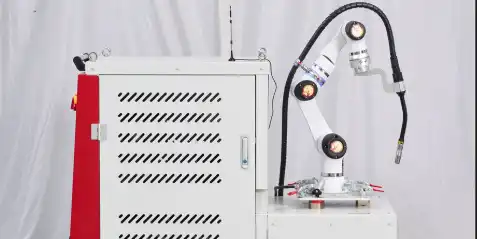
Industrial welding robots work by managing electrical parameters and controlling motion in a coordinated way. The controller of the system tells the servo motors exactly where to place the welding torch along paths that have already been planned. The power source changes the voltage and wire feed speed at the same time based on the thickness of the material and the shape of the joint. Modern robotic arm welding machines have seam tracking sensors that find the edges of parts and adjust for differences in fit-up in real time. This keeps the torch standoff distance at the right level during every cycle.
Key Technologies Driving Performance
Through-Arc Seam Tracking (TAST) uses electrical input from the welding arc to find the centerlines of grooves without the need for extra instruments. Structured light patterns are projected onto workpieces by laser vision systems. This makes 3D profiles that help with path changes. Hollow-wrist designs run cables through the arm's center axis, which stops interference from outside cables and lets the torch rotate 360 degrees all the time. Together, these technologies make placing accurate to within ±0.05mm over millions of rounds, making sure that every weld meets engineering standards.
Industrial Impact and Strategic Value
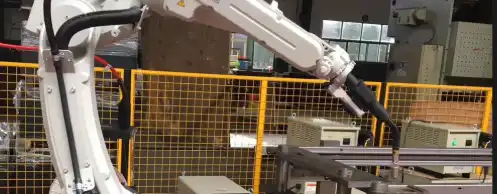
In auto assembly plants, robotic welding cells put body panels and structural supports together. These cells do spot welds every millisecond, which is timed to match the speed of the conveyors. Heavy equipment makers use automatic systems to do multi-pass welds on thick steel plates. These systems keep the penetration depth constant, which is something that human workers can't do when they work overtime. Fabricators of pressure vessels use robotic arms and rotary positioners to weld circumferential seams while the vessels are flat. This makes joints that are good enough for X-rays and meet ASME standards for use in critical infrastructure.
Robotic Arm Welding Machines vs Traditional Welding: A Comparative AnalysisQuality Consistency and Process Control
The quality of manual welding depends on how tired the user is, how bright the area is, and how easy it is to get to the joint. When doing the same thing over and over, even qualified welders' performance changes, which leads to uneven bead shapes and penetration depths. Automated systems get rid of these differences by giving each part the same electrical parameters and motion sequences. A robotic arm welding machine keeps track of the welding data for every cycle, which helps with quality checks and efforts to keep getting better.
Safety and Ergonomic Considerations
There are risks at work for welders, such as being exposed to ultraviolet radiation, breathing in metal fumes, and hurting their muscles and bones from working in awkward positions. Robotic cells keep arc flash and fumes inside protected areas with ventilation systems, keeping people out of dangerous places. As operators move up to managerial jobs that involve programming and quality checking instead of torch manipulation, the number of injuries goes down while production stays the same.
Economic Analysis for Decision-Makers
Depending on the payload capacity and other equipment, the initial capital investment for an automated welding system is usually between $150,000 and $400,000. For medium-volume producers, on the other hand, savings on labor costs, lower rework costs, and higher throughput usually mean a good return on investment within 18 to 24 months. The main things that determine the choice are the complexity of the part and the amount of production. High-mix, low-volume operations may still be able to use hand welding, but dedicated product lines that make more than 5,000 units a year would benefit from automation.
How to Choose the Right Robotic Arm Welding Machine for Your BusinessTechnical Specification Requirements
The payload capacity tells you how much of a torch and cable assembly the arm can move without losing its accuracy. Most MIG and TIG torches can fit in standard setups that can handle 6 kg to 20 kg. Working reach tells you how much space the robot can access. For example, small fabrications can be done in cells with a reach of 1,400 mm, while large structure welding needs a reach of 3,100 mm to cover big workpieces. The number of axes affects the range of motion that can be done. Six-axis arms provide standard coverage, while seven-axis designs add extra joints to help users avoid obstacles in crowded workspaces. Choosing the right robotic arm welding machine requires balancing these reach and payload needs.
Integration and Programming Capabilities
Offline programming (OLP) software for Windows lets engineers test weld lines on CAD models before they are made, which cuts down on downtime during program development. Frontline workers can use drag-and-drop training features to physically move the torch along seams they want, and the controller will record the locations so they can be played back automatically. Graphical user interfaces make it easier to change tasks, so you can quickly change the speed of travel and the weave patterns without needing to know a lot about programming. These features for ease of use speed up rollout and make it easier to adapt to changes in engineering.
Supplier Selection Criteria
By working with well-known makers, you can be sure that you will have access to expert help networks and replacement parts for the whole life of the equipment. Make sure that providers keep enough spare parts on hand and offer fitting help from qualified techs. Mechanical parts and electrical systems should be covered by warranties for at least 12 months, with options for longer periods of time. Training programs that teach operators how to do their jobs and show them how to do repair work protect your investment by making your employees more skilled.
Procurement Guide: Buying, Leasing, and Maintaining Robotic Arm Welding Machines
Acquisition Strategy Comparison
Buying tools directly gives you full ownership and benefits from depreciation, but you have to set aside a lot of money up front. Leasing plans lower starting costs and keep cash flow for working capital needs, but the total cost over the term of the contract is higher than the purchase price. Used equipment markets have lower prices on late-model robots, which is good for businesses that want to test automation ideas before committing to new systems. Based on your company's capital structure and growth path, each method weighs the financial risk against the operational freedom. A thorough installation plan and preparation of the workers are necessary for a successful robotic arm welding machine execution.
Before the equipment arrives, facility assessments figure out what power supplies are needed, how much floor space is needed, and where to put the safety barriers. Operator training should cover both normal operations and simple repair steps that keep downtime to a minimum when small problems happen. Scheduled preventative maintenance tasks like lubrication, cable inspection, and calibration verification help machines last longer and keep their accuracy over years of continuous use.
Compliance and Workplace Safety
According to ISO 10218-1 standards for industrial robot safety, robotic welding cells must have safety interlocks, light curtains, or other physical barriers that keep people out while the robots are working. At control posts, emergency stop buttons let the system be turned off right away in case of danger. Risk assessments should look at possible ways that something could go wrong and include safety measures that keep workers safe while keeping production running smoothly. When safety is properly integrated, it shows that you are following the rules and lowers your liability exposure.
Future Trends and Innovations in Robotic Arm Welding Machines
Artificial Intelligence and Adaptive Control
Machine learning algorithms now look at weld quality metrics in real time and change parameters on their own to account for differences in materials and changes caused by heat. Predictive maintenance systems keep an eye on the performance of servo motors and the temperatures of their bearings, planning service visits before they break. These smart features lower the amount of scrap and unexpected downtime, making the robotic arm welding machine work better overall than fixed-parameter setting alone could.
Collaborative Robotics and Flexible Manufacturing
Collaborative robots (cobots) with force-limiting technology can work alongside humans without safety nets. This allows for hybrid processes that combine the regularity of robots with the problem-solving skills of humans. With quick-change tooling systems, a single robot can quickly switch between jobs like welding, moving materials, and inspecting. This makes the best use of assets in production settings that are always changing. This adaptability helps manufacturing strategies that change quickly in response to changes in what customers want.
Sustainability and Energy Efficiency
Inverter technology in modern power sources cuts the amount of electricity used by 30% compared to older units that use transformers. Optimized weld plans cut down on the need for filling metal and grinding after the join, which cuts down on waste and extra work. These changes to the environment are in line with companies' efforts to be more environmentally friendly, and they also lower running costs, giving manufacturers who are thinking ahead two benefits.
Conclusion
Automated welding technology is a smart investment that solves problems like a lack of workers, inconsistent quality, and safety issues in industrial fabrication settings. When switching from manual to robotic welding, you need to carefully look at the technical specs, source skills, and financial structures to make sure they meet your production needs. Companies that use the robotic arm welding machine deliberately set themselves up to compete well in markets that need accuracy, stability, and the ability to grow.
FAQ
1. What distinguishes robotic welding from manual processes?
Robotic systems follow pre-programmed motion sequences and can repeat positions within 0.05 mm. They also keep the same travel speed and torch angles for long periods of time, which is something humans can't do. With this level of accuracy, a robotic arm welding machine ensures thousands of similar parts have the same bead shapes and penetration depths.
2. How long does programming typically require?
Engineers can make weld paths from CAD models in two to four hours for complicated assemblies using offline programming software. Teach pendant methods in which the operator guides the torch by hand take 30 to 60 minutes per part and don't require any programming knowledge. When compared to old text-based programming languages, modern drag-and-drop interfaces make setup much faster.
3. What kinds of upkeep make things reliable?
Every month, you should check the condition of the wire drive roll, the levels of the cooling system fluid, and the wear on the cables. Using calibration fixtures, Tool Center Point (TCP) accuracy is checked every three months. Long-term performance is maintained by lubricating the bearings once a year and checking the servo motor encoders. Most parts can work for 50,000 hours or more before they need to be replaced.
Partner with Yuhui Laser for Your Automation Needs
Shandong Yuhui Laser Technology Co., Ltd. delivers enterprise-grade robotic arm welding machine systems engineered for precision manufacturing environments. Our CE and ISO certified equipment achieves ±0.05mm repeatability across multi-axis operations, backed by THF4 military-grade optical components that maintain stable performance during continuous 24/7 production. We support factory-direct procurement with 14-day lead times and comprehensive 450-day warranty coverage, eliminating distributor markups while ensuring responsive technical support. Whether you require OEM customization, integration assistance, or turnkey automation solutions, our engineering team provides tailored recommendations that align with your production goals. Contact jianghui@yuhui-laser-tech.com to discuss your welding automation requirements with our application specialists or visit yuhui-laser-tech.com to explore our complete portfolio of industrial laser and robotic welding systems designed for discerning manufacturers seeking reliable automation partners.
References
1. American Welding Society. (2023). Robotic Welding Handbook: Technology, Applications, and Best Practices. Miami: AWS Publications.
2. International Federation of Robotics. (2024). World Robotics Report: Industrial Robots in Manufacturing. Frankfurt: IFR Statistical Department.
3. Lincoln Electric. (2022). The Procedure Handbook of Arc Welding, 15th Edition. Cleveland: The Lincoln Electric Company.
4. Nof, S.Y. (2023). Handbook of Automation and Robotics in Manufacturing. Berlin: Springer International Publishing.
5. Society of Manufacturing Engineers. (2024). Advanced Welding Technologies: Automation, AI, and Industry 4.0 Integration. Dearborn: SME Technical Publications.
6. Welding Institute. (2023). Quality Assurance in Automated Welding Systems: ISO Standards and Implementation Guidelines. Cambridge: TWI Press.
Contact us directly for customized solutions, quotations and long-term strategic cooperation.