- English
- French
- German
- Portuguese
- Spanish
- Russian
- Japanese
- Korean
- Arabic
- Greek
- German
- Turkish
- Italian
- Danish
- Romanian
- Indonesian
- Czech
- Afrikaans
- Swedish
- Polish
- Basque
- Catalan
- Esperanto
- Hindi
- Lao
- Albanian
- Amharic
- Armenian
- Azerbaijani
- Belarusian
- Bengali
- Bosnian
- Bulgarian
- Cebuano
- Chichewa
- Corsican
- Croatian
- Dutch
- Estonian
- Filipino
- Finnish
- Frisian
- Galician
- Georgian
- Gujarati
- Haitian
- Hausa
- Hawaiian
- Hebrew
- Hmong
- Hungarian
- Icelandic
- Igbo
- Javanese
- Kannada
- Kazakh
- Khmer
- Kurdish
- Kyrgyz
- Latin
- Latvian
- Lithuanian
- Luxembou..
- Macedonian
- Malagasy
- Malay
- Malayalam
- Maltese
- Maori
- Marathi
- Mongolian
- Burmese
- Nepali
- Norwegian
- Pashto
- Persian
- Punjabi
- Serbian
- Sesotho
- Sinhala
- Slovak
- Slovenian
- Somali
- Samoan
- Scots Gaelic
- Shona
- Sindhi
- Sundanese
- Swahili
- Tajik
- Tamil
- Telugu
- Thai
- Ukrainian
- Urdu
- Uzbek
- Vietnamese
- Welsh
- Xhosa
- Yiddish
- Yoruba
- Zulu
Top-rated air-cooled handheld fiber laser welding machines for metal fabrication
When you're searching for cutting-edge welding technology that combines portability with professional-grade performance, air-cooled handheld fiber laser welding machines stand out as the definitive choice for modern metal fabrication. These new systems make it easier to work with materials like stainless steel, aluminum, and galvanized sheets by getting rid of the need for complicated water-cooling systems. North American manufacturers and wholesalers depend more and more on these small, efficient machines because they solve real production problems like limited movement, high maintenance costs, and low throughput without lowering weld quality.

Understanding Air-Cooled Handheld Fiber Laser Welding Machines
How Air-Cooled Technology Works
Air-cooled fiber laser welders use high-frequency heat pipes and advanced phase-change cooling systems to get rid of heat energy by forcing air through the machine. Traditional water-cooled models need chillers, pumps, and pipes that are outside the machine. These machines, on the other hand, have all the cooling parts built into a single unit. The technology relies on strategically placed heat sinks and improved air-duct designs to keep laser diode temperatures within safe ranges, even when they are running all the time. This engineering approach cuts the machine's size down to about a third of what similar water-cooled systems take up and its weight down to 40–70 kg.
These welders can be used in both climate-controlled workshops and outside repair spots because their cooling efficiency stays the same from -20°C to 45°C. An air-cooled handheld fiber laser welding machine can get rid of heat as well as water-cooled systems at the same power levels, which are usually between 800W and 1500W, with center wavelengths of 1080nm and beam quality (M2) scores below 1.1. This technical similarity means that the welding depth and penetration are the same, but you don't have to deal with the hassles of managing liquid water.
Core Applications Across Industries
Metal production shops that work with sheet metal, stainless steel, and making tools find these portable welders very useful for jobs that need to be moved around a lot. They are used by companies that make automotive parts to join body panels and brackets precisely, and companies that make aerospace parts like how they can make high-integrity welds on aluminum and titanium parts. The machines work great in three-dimensional situations where regular machines don't do well: fixing infrastructure on-site without access to water-cooling systems, workshops with limited space where moving workpieces around is important, and high-temperature manufacturing areas where dust and heat make water-coolers less effective.
It can be used for more than just welding. Modern models have many processing modes that can be easily switched between. For example, they can cut thin gauge materials, clean up surface oxidation, and get rid of rust. Because it can do more than one thing, you don't have to buy different pieces of tools. This saves you money and time by streamlining your production process. For different amounts of materials and joint shapes, operators can switch between continuous and pulse modes. Welding wire sizes range from 0.8mm to 1.6mm, based on the needs of the job.

Top-Rated Air-Cooled Handheld Fiber Laser Welding Machines in 2026
Market Leaders and Performance Benchmarks
On the global market, there are a number of well-known companies that make reliable air-cooled handheld fiber laser welding machines. Raycus has become a reliable source for laser sources, and their parts are used in many OEM- and branded machines. Their fiber lasers have an awesome electro-optical conversion efficiency of more than 30%, which means they use less power and cost less to run. Han's Laser and IPG are two companies that make full welding systems with built-in safety features and settings. JPT, on the other hand, makes high-peak-power sources that work best with reflective materials like copper and aluminum.
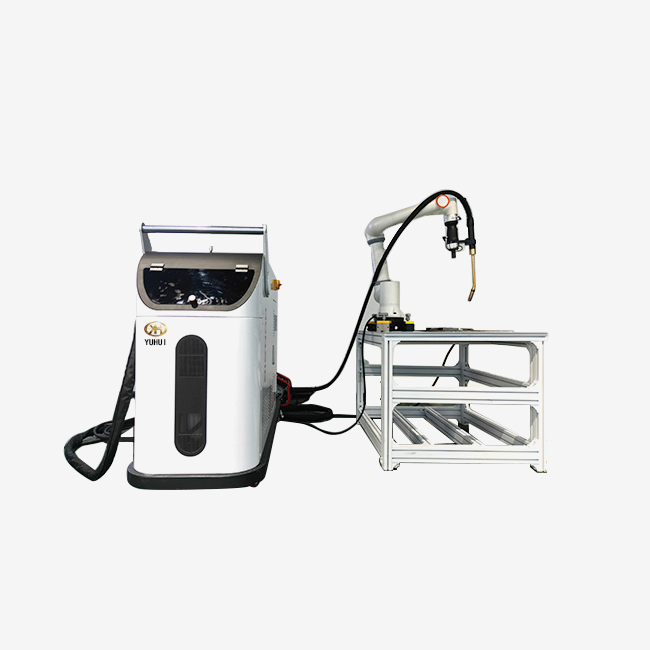
Yuhui Laser built the HJ-1200 model around tested Raycus laser technology. It has a small 53x27x60 cm size and a stable 1200 W output. The machine is very light (only 40 kg), so it can be used in both the workshop and the field. Using THF4 military-grade optical parts in our method makes it unique; they ensure uniform beam quality and longer service life. The full aluminum chassis makes it durable without being too heavy, and the simplified control interface cuts the time it takes to train an operator from days to just hours.
Performance tests show that when set up correctly, air-cooled systems can reach the same weld penetration depths as water-cooled units using the same amount of power. The metallurgical results of a 1500W air-cooled welder on 5mm stainless steel are the same as those of a water-cooled welder, but the setup and shutdown times are much shorter. This practical flexibility is important when production plans require quick changes or when equipment needs to serve many desks in a building.
Cost-Effectiveness and Total Ownership Value
The purchase price is only one part of an investment's long-term value. The initial cost of an air-cooled welder is usually a little higher than the initial cost of a basic water-cooled model, but the total cost of ownership calculations clearly favor air-cooling. You stop having to pay for things like distilled water, cooling chemicals, and new pumps on a regular basis. Maintenance times get much longer, and daily tasks like checking the coolant level, trying the water quality, and servicing the pump are replaced with simple tasks like cleaning the protective lens and inspecting the air filter every so often.
Another benefit is that it uses less energy. Air-cooled systems can run on standard 220V lines with lower amperage needs because they don't have fans and chillers constantly drawing power. This energy economy grows over time, which is especially helpful in places where electricity costs a lot. Companies that want to get sustainability certifications should also care about the environmental benefits of these machines, which get rid of the need to worry about how to get rid of coolant and use no water at all.
How to Choose the Best Air-Cooled Handheld Fiber Laser Welding Machine
Matching Specifications to Production Needs
To choose the right equipment, you must first be honest about what you need to weld. Minimum power requirements depend on the type of material and the thickness range. For most uses with stainless steel and carbon steel up to 3 mm, 1000W is enough, but because they reflect light, aluminum and galvanized materials need 1200W or higher outputs. The duty cycle needs depend on the amount of production; factories that make a lot of things need machines that can run all the time, not just sometimes.
Different applications have different portability needs. Fabricators who work in workshops want small sizes and wheels built in so they can move tools between workstations easily. Field service workers, on the other hand, need designs that are so light that a single person can carry them. The weight point of 40 kg is the best mix between being light enough to move around easily and being heavy enough to stay stable while in use. When machines weigh more than 60 kg, they lose the portable benefit that makes an air-cooled handheld fiber laser welding machine unique.
When filler material is needed, the ability to feed wires is important. Multi-position wire feeders that can hold consumables from 0.8mm to 1.6mm give you options for both thin gauge and structural welding jobs. When combining different metals or heat-sensitive materials, pulse mode is necessary because it delivers exact energy without putting too much heat into the system. These requirements have a direct effect on your ability to get and finish a wide range of fabrication jobs.
Evaluating Supplier Reliability and Support
The choice of supplier is just as important as the choice of tools. Companies that have both ISO9001 and CE certifications show that they are dedicated to quality control systems and safety standards for their products. These qualifications show that the production process follows written steps and that the equipment complies with international safety standards for electromagnetic compatibility and worker protection. Companies that sell goods in North America need to get FDA approval because it shows that they follow more rules.
Your long-term operational success depends on how well your after-sales service architecture works. Manufacturers of equipment that offer 450-day warranties show that they are confident in the stability of their products and give customers more time to fix problems that come up out of the blue. Through technical training programs, you can make sure that your operators know the right way to set up, maintain, and fix problems. Installation help is important, especially for businesses that are buying their first laser welding system, because setting it up correctly at the start keeps performance problems from happening later on.
These ideas are at the heart of how we help people at Yuhui Laser. Our 14-day production lead time from order confirmation means you won't have to wait months for delivery, and the 450-day service period covers both parts and expert advice. Having a large stockpile means that new parts and popular consumables can be shipped right away, without having to wait for backorders. These operational details show which suppliers really want to build long-term relationships with their customers and which ones are only interested in making one-time sales.
Advantages of Air-Cooled Fiber Laser Welding Machines over Alternatives
Performance Comparison with Traditional Methods
A lot of people still use MIG and TIG welding, but they have a lot of problems compared to fiber laser technology. When you use traditional arc welding, you get big heat-affected zones that can bend thin materials and weaken the integrity of nearby parts. Cleaning up after a weld takes longer because of the spatter, and the costs of replacing electrodes keep going up. The operator skills needed are much higher. For example, to get consistent TIG welds on thin stainless steel, you need years of experience, but with laser welding, you only need a little training to get consistent results.
Weld quality is about the same with water-cooled laser systems, but they have limitations on how they can be used that are not present with air-cooled systems. The outside chiller takes up important floor room and needs its own electrical lines. Plumbing connections between the chiller and the welding head create places where leaks could happen and make it harder for the operator to move around. Seasonal maintenance problems like freezing risks in the winter and condensation problems in the summer can be avoided by air-cooling. When you have to move around a lot to make irregular pieces that can't be fixed automatically, these motion issues have a direct effect on your output.
When you compare energy efficiency, you can see differences that are important. In contrast to CO₂ systems, which only use about 10% of the electricity they receive, air-cooled fiber lasers turn over 30% of that electricity into useful light output. This basic advantage in efficiency means lower utility bills and less work for HVAC systems that cool buildings. In addition to saving energy, the process produces fewer fumes than arc welding, which makes the air quality in the workshop better and lowers the need for ventilation.
Integration with Modern Manufacturing
Industry 4.0 projects focus on making tools more connected and improving processes using data. These goals can be met with modern air-cooled handheld fiber laser welding machines that are connected to the internet via Ethernet and use standard communication methods. In real time, production tracking tools can keep track of the number of welds, the amount of power used, and error conditions. This clear data lets you plan repair based on how things are actually used, not just on random dates on the calendar.
Software that can be customized can be connected to ERP and MES systems that are already in use. Custom welding programs save the best settings for different combinations of materials and joint shapes, so the results are always the same from one operator shift to the next. When problems happen, remote diagnostics help cut down on downtime because techs can often fix issues through network access instead of having to go to the site. With these digital features, air-cooled handheld fiber laser welding is more of a technology for the future than just an alternative for old methods.
Conclusion
Air-cooled handheld fiber laser welding machines are a big step forward in the technology used to make metal things. They combine the accuracy and efficiency of fiber lasers with the ease of use of air-cooling systems. These flexible tools get rid of the usual problems with moving equipment around and keeping it in good shape, and they can weld stainless steel, aluminum, and galvanized materials to a professional level. The technology solves real production problems like limited portability, high costs, and heavy upkeep, which makes it especially useful for job shops, field service operations, and manufacturing facilities with limited room. As companies look at their plans for making welding tools, air-cooled systems offer strong total cost of ownership benefits while also performing as well as water-cooled options.
FAQ
1. Can air-cooled welders handle thick materials?
Laser power output is directly related to the thickness capacity of the material. It is possible to weld stainless steel and carbon steel up to 3–4 mm thick with a 1200W system in a single pass. However, aluminum needs higher power levels that can be reached with 1500W units for the same thickness ranges. For thicker materials, multi-pass welding or systems with more power work best. The type of cooling (air vs. water) doesn't affect the amount of material that can be absorbed; what matters is the power output and quality of the beam.
2. How does maintenance differ from water-cooled systems?
Protective lens cleaning with rubbing alcohol and lint-free cloths is all that needs to be done every day. Checking the air filter and cleaning the cooling fins are chores that need to be done every week. Water-cooled systems need to have their coolant levels checked every day, the water quality tested every week, the filters changed every month, and the pump serviced once a year. The overall time savings make air-cooling a much better choice, especially in businesses with multiple shifts where repair windows are limited.
3. What safety precautions are essential?
Class 4 laser safety rules must be followed when cutting with a laser. Laser safety glasses with a 1080nm wavelength rating must be worn by operators. Contact sensors in modern handheld systems stop the laser from shining unless the nozzle touches the workpiece. This eliminates the risk of accidental exposure. Enough air flow gets rid of the metal fumes that are made when you weld. Electrical dangers can be avoided with proper grounding, and emergency stop buttons let you turn off the power right away.
Partner with Yuhui Laser for Reliable Welding Solutions
Manufacturers looking for a reliable provider of air-cooled handheld fiber laser welding machines will find that Yuhui Laser is the best option because of our mix of tested technology and customer-focused support. Our HJ-1200 model has professional-grade performance at factory-direct prices. It has THF4 military-grade optics, Raycus laser sources, and a strong aluminum body. It's really portable, with a 53x27x60 cm size and a weight of 40 kg. It can also be used in multiple modes, including welding, cutting, and cleaning, so it can be used for a wide range of manufacturing jobs.
We back up every machine with a 450-day guarantee and full expert support, so you can be sure that your investment will keep giving you results for a long time. Your equipment will get to you quickly and safely thanks to 14-day production wait times and strong logistics partnerships. Our engineering team is here to help you at every step, whether you need stock configurations or solutions that are made to fit your unique needs. Email us at jianghui@yuhui-laser-tech.com to talk about your welding needs and get a detailed quote that fits your production needs.
References
1. Laser Institute of America. (2023). "Handheld Laser Welding Technology: Safety Standards and Best Practices." Industrial Laser Solutions Journal, Volume 38, Issue 4.
2. Schmidt, M. and Otto, A. (2024). "Comparative Analysis of Cooling Systems in Portable Fiber Laser Welding Equipment." International Journal of Advanced Manufacturing Technology, Volume 121, Pages 2847-2863.
3. Chen, L. and Wang, H. (2023). "Energy Efficiency and Environmental Impact of Modern Laser Welding Systems." Welding Research Council Bulletin, Number 568.
4. Manufacturing Technology Institute. (2024). "Total Cost of Ownership Models for Industrial Laser Equipment." MTI Research Report Series, Document MTI-2024-17.
5. European Welding Federation. (2023). "ISO 11553-2 Compliance in Handheld Laser Processing Equipment." EWF Technical Guidelines, Edition 3.
6. Thompson, R. (2024). "Air-Cooled Versus Water-Cooled Laser Systems: A Procurement Decision Framework." Industrial Equipment Digest, March 2024 Edition, Pages 34-41.
Contact us directly for customized solutions, quotations and long-term strategic cooperation.