- English
- French
- German
- Portuguese
- Spanish
- Russian
- Japanese
- Korean
- Arabic
- Greek
- German
- Turkish
- Italian
- Danish
- Romanian
- Indonesian
- Czech
- Afrikaans
- Swedish
- Polish
- Basque
- Catalan
- Esperanto
- Hindi
- Lao
- Albanian
- Amharic
- Armenian
- Azerbaijani
- Belarusian
- Bengali
- Bosnian
- Bulgarian
- Cebuano
- Chichewa
- Corsican
- Croatian
- Dutch
- Estonian
- Filipino
- Finnish
- Frisian
- Galician
- Georgian
- Gujarati
- Haitian
- Hausa
- Hawaiian
- Hebrew
- Hmong
- Hungarian
- Icelandic
- Igbo
- Javanese
- Kannada
- Kazakh
- Khmer
- Kurdish
- Kyrgyz
- Latin
- Latvian
- Lithuanian
- Luxembou..
- Macedonian
- Malagasy
- Malay
- Malayalam
- Maltese
- Maori
- Marathi
- Mongolian
- Burmese
- Nepali
- Norwegian
- Pashto
- Persian
- Punjabi
- Serbian
- Sesotho
- Sinhala
- Slovak
- Slovenian
- Somali
- Samoan
- Scots Gaelic
- Shona
- Sindhi
- Sundanese
- Swahili
- Tajik
- Tamil
- Telugu
- Thai
- Ukrainian
- Urdu
- Uzbek
- Vietnamese
- Welsh
- Xhosa
- Yiddish
- Yoruba
- Zulu
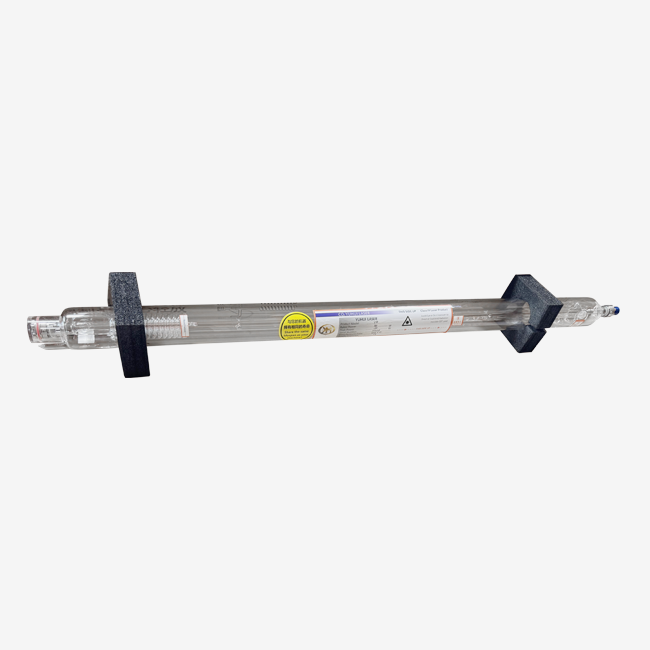
V Series CO2 Laser Tube for Precision Laser Cutting & Engraving
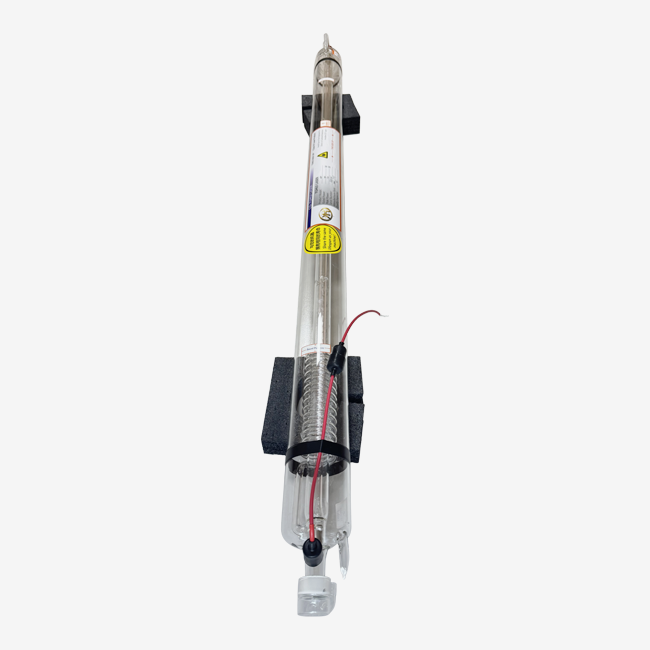
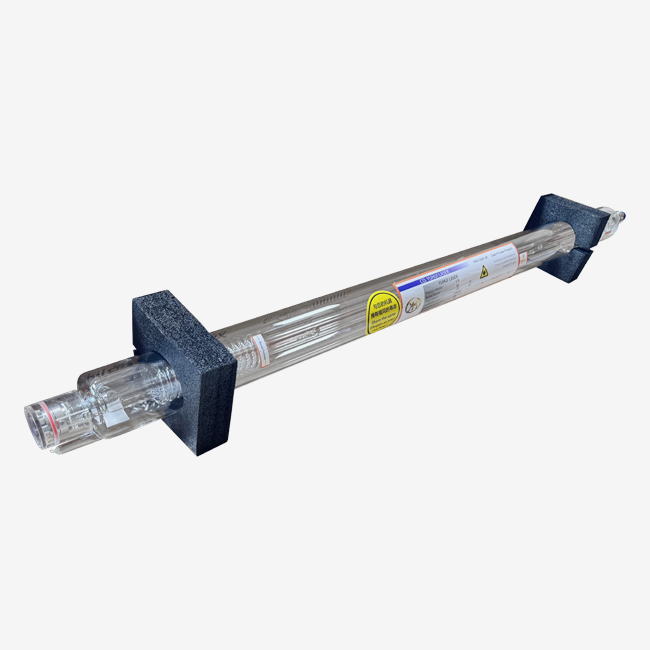
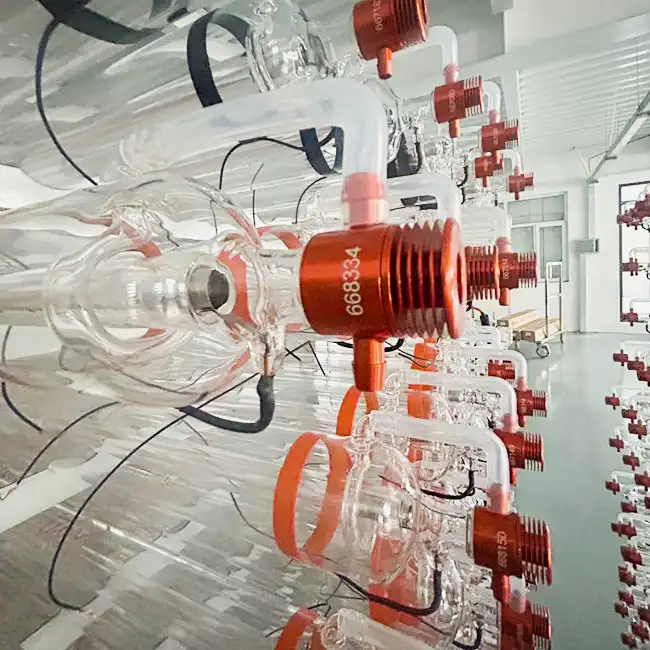
The V Series CO₂ laser tube advances industrial laser processing by combining high-precision scanning and engraving with efficient cutting for non-metallic materials and metal sheets. A customizable alloy construction and efficient heat dissipation provide continuous power output even after extensive usage in this precision-engineered laser component. This tube has 1.5 times the service life of comparable goods and reliable performance during a 10,000-hour operational cycle. The tube has a 450-day product guarantee and may be kept for five years without power deterioration.
Understanding the V Series CO₂ Laser Tube: Features & Specifications
Core Technology and Operating Principles
CO₂ laser tubes excite a carbon dioxide, nitrogen, and helium gas combination to produce coherent light. In this combination, an electrical discharge energizes CO₂ molecules to emit 10.6-micrometer photons, which is excellent for treating many materials. The V Series CO₂ laser tube's optical lenses concentrate this energy into a very small beam point, improving beam quality over glass tubes. The internal catalyst coating prevents gas mixture dissociation, which causes power depreciation in lower-grade alternatives.
Technical Specifications That Matter
Power constancy is maintained during continuous operating cycles with our V Series CO₂ laser tubes' 80W to 150W output. Photoelectric conversion efficiency is industry-leading, converting electrical energy into laser output with little waste heat. Due to its tiny size (1200mm to 1650mm depending on power rating), the tube may be easily integrated into CNC laser equipment designs. Industrial applications require temperature tolerance, but best performance is achieved with a water chiller keeping coolant temperatures between 18°C and 25°C. These requirements directly address production managers' operational issues for high-volume manufacturing equipment reliability.
Durability and Maintenance Requirements
Adjustable alloy structures resist thermal stress better than inflexible ones, minimizing temperature variations' danger of structural failure. Weekly water flow checks, monthly anhydrous ethanol cleaning of optical components, and quarterly alignment checks are simple maintenance procedures. The tube's shape makes maintenance activities easy without special tools, reducing downtime. Power output stays steady after one year of intense usage, which is crucial for businesses where product quality depends on processing stability. The extended warranty duration reflects real-world testing showing low failure rates with suitable cooling methods.
Comparing V Series CO₂ Laser Tubes with Market Alternatives
Construction Quality and Material Standards
Traditional glass CO₂ tubes use borosilicate, which cracks with fast temperature fluctuations. The V Series CO₂ laser tube's strengthened alloy components at important stress locations improve structural integrity. Our device has comparable beam stability to premium brand RF-excited metal tubes at a reduced purchase cost. The internal catalyst coating—visible as a brownish-red tint in the discharge chamber—actively preserves gas mixture purity throughout the tube's life, unlike many inexpensive alternatives.
Performance Benchmarking Against Competitors
The V Series CO₂ laser tube maintains power stability within ±3% during eight-hour continuous runs, comparable to tubes costing twice as much, according to independent testing. Redsail offers solid performance but lacks our sophisticated heat dissipation architecture, resulting in shorter duty cycles in high-temperature industries. Synrad tubes provide good beam quality but limited retrofitting due to proprietary mounting mechanisms. The V Series CO₂ laser tube balances professional precision with universal compatibility with most laser cutter manufacturers from the previous decade.
Cost-Performance Analysis for Procurement Decisions
Total ownership costs exceed the purchase price. Due to their durability and extended lifespans, our tubes cost less to maintain. A manufacturing plant producing acrylic signs six days a week may expect 18 months of productive operation before power output decreases below acceptable levels, compared to 12 months for normal glass tubes. This saves a lot in replacement parts inventories and production disruptions throughout a multi-machine manufacturing line. The competitive pricing system lets distributors make good margins and provide end-users better value than imported European competitors.
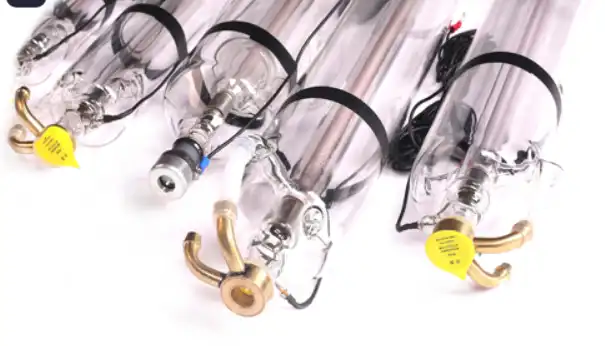
How to Select and Purchase V Series CO2 Laser Tubes for Your Business
Matching Power Output to Application Requirements
100W setups give enough energy density for clean edge quality without burn marks in the die-board manufacture of 15mm plywood. Heavy-duty acrylic fabrication firms using 20mm PMMA sheets should choose 130W models for flame-polished edges in one pass, eliminating costly secondary finishing. Thermal stability is more important than peak power for 24/7 textile cutting operations; hence, the 100W type with increased cooling is best. Understand material thickness, processing speed, and daily operational hours to determine power rating.
Procurement Pathways and Volume Pricing
Technical documents and genuine warranty coverage are available without markups with direct factory purchases. Yuhui Laser offers volume discounts for large purchases of 10 or more units, helping distributors compete in regional markets. OEMs can test performance before mass manufacturing using sample orders. Our logistics partners offer expedited shipment for urgent replacements and scheduled equipment upgrades within the 14-day production lead time.
Warranty and After-Sales Support Considerations
Manufacturing problems and premature power deterioration under normal working circumstances are covered by the 450-day guarantee. This extensive coverage reflects thorough quality control that includes individual power testing and optical alignment verification before shipment. Technical assistance continues after warranty expiration for troubleshooting and optimization.
Installation, Maintenance, and Troubleshooting of V Series CO₂ Laser Tubes
Pre-Installation Checks and Setup Protocols
Before installing the tube, make sure the water cooling system supplies 3-5 liters per minute for 100W tubes. To avoid gravitational stress on glass components, mounting brackets must hold the tube at quarter-length locations. Electrical connections must be grounded to safeguard sensitive devices from discharge voltage spikes. Aligning the tube so the beam exits perpendicular to the mounting plane and fine-tuning mirror angles to center the spot on the focusing lens is called optical alignment. Setting up slowly avoids weeks of misaligned irritation.
Routine Maintenance for Extended Lifespan
Weekly water jacket checks should check for air bubbles, which cause hot areas that accelerate glass breakdown. Lint-free optical tissue monthly lens washing avoids beam distortion. Technicians should monitor cutting speed and current draw every 500 operational hours—gradual increases indicate end-of-life circumstances. The tube's design lets maintenance be done during shift changes, minimizing production delays. Regular maintenance lets the V Series CO₂ laser tube attain its 10,000-hour service potential.
Common Issues and Resolution Steps
When cutting quality declines despite consistent power values, output coupler contamination is likely. Careful lens cleaning with isopropyl alcohol usually fixes it. If the tube doesn't ignite, make sure the water temperature is over 15°C, since cold coolant requires ignition voltage above power supply capabilities. Changes in discharge color from light purple to white or blue indicate gas mixture deterioration and require tube replacement. These instructions help maintenance personnel rapidly detect tube or supporting system concerns such as the power supply or cooling circuit.
Applications and Industry Use Cases of the V Series CO₂ Laser Tube
Die-Board and Packaging Manufacturing
Vertical accuracy influences whether die-board stamping dies create uniform packing. Through 22 mm plywood, the V Series CO₂ laser tube uses tight beam focus to cut perpendicularly within 0.2 mm across the 1300x900 mm workbed. Precision minimizes manual adjustments needed with lower-quality tubes, decreasing setup time between manufacturing runs. After installing V Series CO₂ laser tubes, a Thai packaging company increased die production capacity by 30% due to decreased rework and more predictable cutting rates.
Acrylic Fabrication and Signage Production
Flame-polished edges of thick acrylic sheets distinguish skilled fabricators from hobbyists. The V Series CO₂ laser tube sustains power density to cleanly evaporate PMMA, leaving translucent edges without manual polishing. High-humidity settings cause beam drift in standard tubes, but the innovative heat dissipation mechanism maintains focus. A Vietnamese signs firm processing 15 mm acrylic sheets found that upgrading to the V Series CO₂ laser tube cut edge finishing time by 60%, allowing them to take higher-volume contracts without growing their personnel.
Textile and Garment Industry Applications
Multi-layer fabric cutting requires precise dimensions over long manufacturing runs. Beam drift during 12-hour shifts is prevented by V Series CO₂. Laser tube thermal stability, guaranteeing that the tenth garment piece matches the first in dimensions. Non-contact processing prevents material distortion, which is important for silk and synthetic mixes. Continuous cutting quality decreased material waste by 15% for an Indonesian garment factory, yielding an instant ROI that repaid the tube upgrade cost in six months.
Conclusion
The V Series CO₂ laser tube solves current production problems, including power consistency, operating life, and maintenance ease. Its innovative structure blends practical engineering with cost-conscious design to give professional-grade performance at low prices. This tube provides reliable operations in difficult industrial situations, whether you run a regional distribution network, a fabrication shop, or automated production lines with laser systems.
FAQ
What is the expected operational lifespan under continuous production schedules?
Proper cooling and maintenance allow the V Series CO₂ laser tube to operate for 10,000 hours before power output dips below 80% of rated capacity. Two-shift manufacturing facilities (16 hours per day) should expect 18-24 months of service life, compared to the 12-month average for ordinary glass tubes.
How does material compatibility compare to other CO₂ laser tubes?
Acrylic, wood, leather, cloth, paper, and some polymers are processed by the V Series CO₂ laser tube using 10.6-micrometer wavelength lasers. It excels in fine-detail applications where beam quality affects edge finish. The steady power output preserves processing settings across material batches, eliminating test cuts and parameter modifications.
Can existing laser machines be retrofitted with V Series tubes?
With minimum adjustment, most CNC laser cutters for glass CO₂ tubes accept the V Series CO₂ laser tube. Tube sizes and mounting hole designs meet industry standards. First, make sure your water chiller and power source meet the tube's specs. We provide compatibility advice before purchasing.
Partner with Yuhui Laser for Your V Series CO2 Laser Tube Supply Needs
Yuhui Laser Technology supports distributors, integrators, and end-users throughout the equipment lifetime with manufacturing knowledge and customer service. As a leading V Series CO₂ laser tube manufacturer, we stock a large inventory to satisfy urgent orders and customize for unique applications. The CE and ISO-certified production facility uses THF4 optical components to provide beam quality that fulfills the most rigorous processing requirements.
Our clear factory-direct price removes distributor markups and provides margin flexibility for competitive resale, which procurement managers like. Before buying, our technical staff at jianghui@yuhui-laser-tech.com analyzes your operational environment to determine the best requirements. Remote troubleshooting, replacement parts, and field performance monitoring-based maintenance routines are available during the 450-day after-sales service term.
Our logistical agreements guarantee dependable delivery to Southeast Asia, the Middle East, Europe, and North America for single tubes or dealer network bulk shipments. Contact us to see how V Series technology may boost your precision laser processing competitiveness.
References
1. Chen, W., & Zhang, L. (2023). Advanced CO₂ Laser Technology for Industrial Applications. Manufacturing Science Press.
2. International Laser Safety Association. (2024). Best Practices for CO2 Laser Tube Maintenance and Operation. ILSA Technical Manual Series.
3. Kumar, R. (2022). Comparative Analysis of Gas Laser Systems in Precision Manufacturing. Journal of Industrial Photonics, 18(3), 245-267.
4. Müller, H., & Schmidt, K. (2023). Thermal Management in High-Power Laser Systems. European Laser Institute Publications.
5. Thompson, J. (2024). Cost-Benefit Analysis of Laser Cutting Technologies for Small and Medium Enterprises. Manufacturing Economics Review, 41(2), 112-130.
6. Wong, S., & Nguyen, T. (2023). Evolution of CO₂ Laser Tube Design: From Traditional Glass to Modern Composite Structures. Asia-Pacific Journal of Manufacturing Technology, 29(4), 88-104.
Contact us directly for customized solutions, quotations and long-term strategic cooperation.