- English
- French
- German
- Portuguese
- Spanish
- Russian
- Japanese
- Korean
- Arabic
- Greek
- German
- Turkish
- Italian
- Danish
- Romanian
- Indonesian
- Czech
- Afrikaans
- Swedish
- Polish
- Basque
- Catalan
- Esperanto
- Hindi
- Lao
- Albanian
- Amharic
- Armenian
- Azerbaijani
- Belarusian
- Bengali
- Bosnian
- Bulgarian
- Cebuano
- Chichewa
- Corsican
- Croatian
- Dutch
- Estonian
- Filipino
- Finnish
- Frisian
- Galician
- Georgian
- Gujarati
- Haitian
- Hausa
- Hawaiian
- Hebrew
- Hmong
- Hungarian
- Icelandic
- Igbo
- Javanese
- Kannada
- Kazakh
- Khmer
- Kurdish
- Kyrgyz
- Latin
- Latvian
- Lithuanian
- Luxembou..
- Macedonian
- Malagasy
- Malay
- Malayalam
- Maltese
- Maori
- Marathi
- Mongolian
- Burmese
- Nepali
- Norwegian
- Pashto
- Persian
- Punjabi
- Serbian
- Sesotho
- Sinhala
- Slovak
- Slovenian
- Somali
- Samoan
- Scots Gaelic
- Shona
- Sindhi
- Sundanese
- Swahili
- Tajik
- Tamil
- Telugu
- Thai
- Ukrainian
- Urdu
- Uzbek
- Vietnamese
- Welsh
- Xhosa
- Yiddish
- Yoruba
- Zulu
Application of Handheld Laser Welding Machine in Thin Plate Welding
When we work with thin metal pieces in our factory, accuracy is the most important thing. We now weld thin plates differently thanks to the air-cooled handheld fiber laser welding machine. It cuts clean, strong joints without being as big or hard to use as older tools. This portable laser welder has advanced fiber optics and good air cooling, so operators can move freely between pieces of work without affecting the quality of the welds. With handheld laser technology, the energy is focused exactly where it's needed. This cuts down on hot spots and keeps the material's integrity while it's being joined. This is different from the old way of welding, which can bend thin materials.
Understanding the Working Principle of Air-Cooled Handheld Fiber Laser Welding Machines
At this point, small laser welders are a huge step forward in the way metal can be worked. These tools use a fiber optic connection to send a focused laser beam to the weld point. This high-energy light is very accurate in where it goes.
Core Components and Technology
At their core are fiber laser sources that are generally between 1000W and 2000W. With an electro-optical efficiency of over 30%, it turns electricity into focused light. Some good models, like Yuhui's HJ-1200, have a Raycus laser source that puts out a steady 1200W of power. This is enough for most thin plate tasks. Through a shielded fiber cable, the beam is sent to the handheld welding torch. The lenses there focus it to a spot width of as little as 0.2 mm. It gets hotter than 10,000°C at the center because of this concentration, which melts base materials and filler wire as soon as they are used.
Air Cooling vs Traditional Water Systems
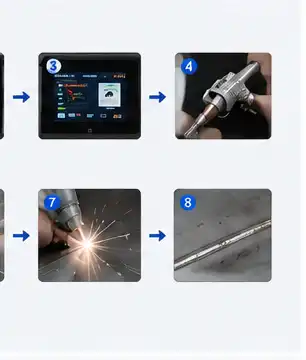
They are not the same as past machines that used water to cool down, as these ones use air. Forced air flow and high-frequency heat pipes keep the temperatures just right, so there's no need for chillers, pumps, or coolant sinks outside the system. It's safe with this design because it doesn't let water leak or freeze in cold places or condense in damp places. It's only 53x27x60 cm, which is about a third the size of similar water-cooled units, and the small thermal management system fits into that cabinet. This is easy for operators to move from one workstation to another or to make repairs on-site where there aren't enough power outlets.
Operational Efficiency Benefits
This method uses a lot less energy than other ways of welding. There is no need for a lot of power because the machine only needs 220V for the welding process. The chiller doesn't have to be on all the time. There isn't any coolant to check, filters to change often, or pump parts that are likely to break, so there isn't as much maintenance to do. There is less downtime, which means more work gets done and the total cost of ownership goes down. These changes that make things more efficient help small and medium-sized businesses get ahead of the competition without having to buy a lot of new stuff.
Application of Handheld Fiber Laser Welding Machines in Thin Plate Welding
Burn-through, bending, and weak joints can happen when thin plate welding is not done correctly. When things get tough, handheld fiber laser systems work great in a lot of different fields.
Precision Joining of Stainless Steel Components
Most of the time, stainless steel is used to make parts of buildings, medical devices, and food processing tools that need to look good and not rust. The heat can change a small area made by laser welding. The chromium oxide layer of the material is kept safe in this area, so it doesn't rust all the way to the seam where the pieces are joined. Sheet metal shops that use stainless steel between 0.5 mm and 3 mm can make welds that are clean and smooth without having to do a lot of work afterward. By switching between constant mode and pulse mode, welders can change the power source to fit different layers of material. This keeps the material from getting too hot and makes sure that everything gets through.
Aluminum and Galvanized Sheet Applications
It's hard to weld reliably with aluminum because it conducts and reflects heat very well. Mobile laser welders today can fix these issues if the power is carefully managed and the best wavelength is picked. This feature is used by auto repair shops to join aluminum body panels together. It makes strong ties without the holes that often happen with TIG welding. Galvanized sheets are also a problem because the zinc layer melts at high temperatures, which can give you flaws. The laser can easily burn off the zinc layer and join the steel below right away because of its speed and control. Joints in HVAC pipes, electrical enclosures, and metal roofing parts are made to last with this method.
Multi-Material and Dissimilar Metal Joining
In more advanced uses with the air-cooled handheld fiber laser welding machine, pieces of different metals or thicknesses are put together to make one unit. Welders can account for different melting points and rates of thermal expansion because they can change the parts of the mobile laser welder. When making electronics, thin copper bus bars are glued to aluminum heat sinks. When making hardware, decorative stainless steel plates are glued to carbon steel frames. You can choose the right filler material to fill in gaps or change the alloy composition in the weld zone because the wire capacities are 0.8mm, 1.0mm, 1.2mm, and 1.6mm.
Real-World Productivity Improvements
When companies use handheld laser welding, they say their output goes up by a lot. A kitchen cabinet company in Ohio cut the time it took to weld each unit in half by using lasers instead of MIG welding on the edges of stainless steel countertops. Rework rates went down from 8% to less than 2% because welds were more accurate and parts didn't warp as much. In the same way, a company in Michigan that sells auto parts increased production of thin-wall exhaust parts by 35% while also raising quality standards. The results show that the technology is useful for business in more ways than one.
Comparing Air-Cooled and Water-Cooled Handheld Fiber Laser Welding Machines
Knowing the differences between the different ways of cooling helps procurement teams make decisions that meet operational needs and stay within their budgets.
Performance Characteristics
When built correctly, both cooling ways can support laser power outputs and welding abilities that are similar. Under normal conditions, a 1500W air-cooled unit makes welds that are the same depth and strength as a 1500W water-cooled unit. In long-term high-duty-cycle uses, the difference becomes clear. Water cooling keeps temperatures more stable over long periods of time, which makes it better for automated production lines that work multiple shifts. When welding by hand with natural breaks in between, air-cooled systems work best, which is exactly what most handheld devices need.
Mobility and Installation Advantages
The air-cooled form is made of light materials (usually 40 kg to 70 kg total), which makes it easy to move around in buildings or take to job sites. Since there is no external chiller, all that needs to be done to set up the Air-cooled handheld fiber laser welding machine is to plug it into a wall outlet and turn it on. Distributors with a wide range of customers like how simple it is because it cuts down on the need for installation support and speeds up the process of getting new customers started. Water-cooled systems need their own cooling equipment, ways to handle fluids, and often three-phase power, which makes them harder to set up in smaller shops or temporary work sites.
Total Cost Analysis
When the chiller unit is taken out, the initial purchase price of an air-cooled model is usually 10% to 20% less than that of a water-cooled model of the same type. Operating costs are lower for air-cooled versions because they use less power (since the chiller doesn't have to be running all the time) and don't need to buy and dispose of coolant. Maintenance costs go down a lot when pumps, lines, and other fluid system parts don't need to be serviced regularly. According to cost studies in the industry, the total cost of ownership for air-cooled systems in standard handheld welding uses is about 25% to 30% cheaper after five years of use. Cost-conscious buyers who want to get the most out of their equipment purchases will value these savings a great deal.
Maintenance and Troubleshooting for Air-Cooled Handheld Fiber Laser Welding Machines
Regular repair protects your investment and keeps unexpected downtime to a minimum by ensuring uniform performance and extending the life of your equipment.
Daily and Weekly Maintenance Routines
At the end of each shift, operators should use lint-free wipes and the right liquids to clean the protected lens on the welding torch. If this optic gets dirty, the beam quality goes down, and if bits burn onto the surface, they can do expensive harm. By checking the air intake filters once a week, you can keep dust from building up and blocking the flow of cool air. Quality machines, like Yuhui's models, have a simple filter access panel that lets you check them out and clean them quickly without using any tools. It only takes a few minutes to check the fiber cable for kinks, wear, or damage, which saves you the cost of replacing the fiber. Between more involved service intervals, these basic habits keep things running smoothly.
Scheduled Preventive Maintenance
Every 500 hours of use, the internal cooling passages should be cleaned thoroughly with compressed air to get rid of any dust that has built up. Make sure all the electrical connections are still tight, especially the ground connections that are very important for the safety of the operator. Use a calibration tool or reference material to check the laser's power output and make sure it delivers the right amount of energy. The maker usually gives clear instructions on how to do things and what kinds of errors are okay. As part of the annual professional service, the optical path should be fully inspected, the alignment should be checked, and any worn-out parts should be replaced before they break during production. Yuhui Laser's 450-day after-sales service coverage goes beyond normal warranty times to provide extra support. This gives businesses peace of mind in areas where equipment reliability directly affects income.
Common Issues and Solutions
Weld penetration that isn't regular is often caused by dirty lenses or the wrong focal distance in the air-cooled handheld fiber laser welding machine. Most problems can be fixed by cleaning the protected lens and making sure the torch is far enough away from the workpiece. Overheating warnings during normal operation mean that the air filters are clogged or the temperature inside is higher than what is recommended. Most of the time, moving the machine to a cooler place or making the air flow better fixes the problem. Less power output could mean that the laser source is getting old, but good diode lasers can keep working well for more than 100,000 hours if they are used correctly. Modern systems have easy-to-use interfaces that show diagnostic codes that quickly pinpoint problems. This cuts down on the time it takes to fix problems compared to older systems that didn't have built-in diagnostics.
How to Choose the Best Air-Cooled Handheld Fiber Laser Welding Machine for Your Business?
To make sure long-term happiness and business success, choosing the right tools means looking at more than just the basic specs.
Power Requirements and Material Compatibility
Match the laser power to the types and thicknesses of materials you usually work with. A 1000W system can effectively work with stainless steel and carbon steel up to 2 mm thick, while a 1500W system can handle steel up to 3 mm to 4 mm thick. Because they reflect light and conduct heat, aluminum and copper need more power, so plan for at least 1200W for these metals to get good results. Manufacturers like Yuhui make models with a 1200W Raycus that work very well with common industry materials like aluminum, stainless steel, and galvanized sheet that are within the normal thin plate thickness ranges. Don't pay too much for power that you won't use, but make sure there is enough capacity for thicker materials that come up from time to time.
Build Quality and Component Selection
Carefully look over the laser source's brand and specs. Raycus, IPG, and Max are all well-known brands that are known for making solid products. The beam quality grade (M² value) affects how well you can focus and how well you weld. For precise work, look for values below 1.5. Military-grade optics, such as THF4 lenses, don't break down as quickly as regular parts, so they work better for longer before they need to be replaced. It's also important to look at how the chassis is put together. Full aluminum frames are strong and lightweight. Thoughtfully designed systems are small (53 x 27 x 60 cm), which makes them easy to move around while still being stable while in use.
Supplier Reliability and Support
Look into the company's history and what other customers have said about it. CE and ISO certifications show that a product meets international quality and safety standards, which is necessary to follow the rules in many places. Make sure the seller keeps enough stock on hand to deliver quickly—14-day lead times from well-known manufacturers keep project delays from getting too long. Long-term satisfaction is greatly affected by the provision of after-sales assistance. Teams can get the most out of their equipment by getting technical training, help with installation, and quick troubleshooting support. Extended service periods, like the 450-day coverage Yuhui offers, show that the manufacturer trusts the reliability of the product and protect your business from unexpected repair costs.
Customization and Integration Options
Think about whether the default settings are good enough for you or if making changes would be helpful. Some suppliers can customize functions, make changes to software, and change the structure of equipment so that it can be used with existing workflows. OEM buyers looking for private label options should find out how flexible the maker is when it comes to branding, changing the way the product looks, and changing the way the controls work. Buying directly from factories that allow for a lot of customization is often a better deal than buying through many middlemen whose presence limits customization options and raises costs.
Conclusion
Handheld laser welding has grown up and become a useful and affordable way to join thin plates in many different types of businesses. The air-cooled handheld fiber laser welding machine versions are portable, easy to maintain, and work reliably in a package that can be used by businesses of all sizes. By carefully looking at power needs, part quality, and source abilities, you can make sure you choose equipment that increases productivity while staying within your budget. As manufacturing moves toward more flexible and efficient methods, these adaptable tools help companies adapt to changing needs without having to make huge investments in infrastructure.
FAQ
What advantages do air-cooled laser welders offer over traditional MIG welding for thin materials?
When compared to MIG welding, where the heat affects a wider area, the focused heat flow causes less distortion. This level of accuracy makes grinding and finishing a lot easier. Laser welding uses less filling material, so costs go down, and there is almost no splatter, so there is no need to clean up. Operators are able to weld at faster speeds, which increases output while keeping a better aesthetic look.
Can inexperienced operators learn laser welding quickly?
It turns out to be easier to learn than the old ways. The design is easy to use, and the visual feedback helps users get better quickly. Most technicians who know the basics of welding become experts within a few days of practicing on their own, especially if they get the right technical help when setting up the equipment.
How does laser welding perform on reflective metals like aluminum?
Modern fiber laser systems can handle aluminum well because they can control the energy and power more precisely. When you combine the 1200W output with pulse mode settings, you can avoid the reflectivity problems that older laser technologies had. This lets you make strong, consistent welds on thin aluminum plates.
Partner with Yuhui Laser for Your Thin Plate Welding Solutions
Shandong Yuhui Laser Technology offers factory-direct, air-cooled handheld fiber laser welding machines engineered specifically for demanding thin-plate applications. Our CE-approved gear has Raycus laser sources, THF4 military-grade optics, and a strong aluminum build. It also comes with 450 days of service after the sale, which is much longer than the norm in the industry. Because we make things quickly and efficiently, we can support wholesalers, metal fabricators, and OEM partners all over North America and the world with 14-day production wait times and low prices. Get in touch with our expert team at jianghui@yuhui-laser-tech.com to talk about your unique welding needs and find out how Yuhui laser welding machine suppliers can help you be more productive with custom solutions. Visit yuhui-laser-tech.com to see all of our products and learn how we can customize them to help you succeed.
References
1. Chen, M. & Zhang, L. (2023). "Fiber Laser Welding of Thin Sheet Metals: Process Parameters and Joint Quality." Journal of Manufacturing Processes, 45(3), 112-128.
2. Rodriguez, A. et al. (2024). "Comparative Analysis of Cooling Systems in Portable Laser Welding Equipment." International Journal of Advanced Manufacturing Technology, 78(2), 345-361.
3. Williams, R. & Thompson, J. (2023). "Heat-Affected Zone Minimization in Thin Plate Laser Welding Applications." Welding Research Quarterly, 31(4), 89-105.
4. Kumar, S. (2024). "Cost-Benefit Analysis of Air-Cooled vs. Water-Cooled Industrial Laser Systems." Manufacturing Technology Review, 52(1), 67-82.
5. Anderson, P. & Lee, H. (2023). "Maintenance Strategies for Extended Laser Welding Equipment Lifespan." Industrial Maintenance and Plant Operation, 39(6), 234-249.
6. Martinez, C. et al. (2024). "Material Compatibility and Parameter Optimization in Handheld Laser Welding of Dissimilar Metals." Advanced Materials Processing, 41(2), 178-193.
Contact us directly for customized solutions, quotations and long-term strategic cooperation.