- English
- French
- German
- Portuguese
- Spanish
- Russian
- Japanese
- Korean
- Arabic
- Greek
- German
- Turkish
- Italian
- Danish
- Romanian
- Indonesian
- Czech
- Afrikaans
- Swedish
- Polish
- Basque
- Catalan
- Esperanto
- Hindi
- Lao
- Albanian
- Amharic
- Armenian
- Azerbaijani
- Belarusian
- Bengali
- Bosnian
- Bulgarian
- Cebuano
- Chichewa
- Corsican
- Croatian
- Dutch
- Estonian
- Filipino
- Finnish
- Frisian
- Galician
- Georgian
- Gujarati
- Haitian
- Hausa
- Hawaiian
- Hebrew
- Hmong
- Hungarian
- Icelandic
- Igbo
- Javanese
- Kannada
- Kazakh
- Khmer
- Kurdish
- Kyrgyz
- Latin
- Latvian
- Lithuanian
- Luxembou..
- Macedonian
- Malagasy
- Malay
- Malayalam
- Maltese
- Maori
- Marathi
- Mongolian
- Burmese
- Nepali
- Norwegian
- Pashto
- Persian
- Punjabi
- Serbian
- Sesotho
- Sinhala
- Slovak
- Slovenian
- Somali
- Samoan
- Scots Gaelic
- Shona
- Sindhi
- Sundanese
- Swahili
- Tajik
- Tamil
- Telugu
- Thai
- Ukrainian
- Urdu
- Uzbek
- Vietnamese
- Welsh
- Xhosa
- Yiddish
- Yoruba
- Zulu
Laser Cutting Machine | Fiber & Tube Laser Buy Guide
When looking for precision metal fabrication tools, it's important to know what modern dual-purpose systems can do. The HT model tube and plate fiber laser cutting machine is a game-changing purchase for companies that want to combine sheet and pipe processing on a single, high-performance platform. This detailed guide walks you through important selection criteria, technical details, and practical insights to make sure that the product you buy will improve productivity, quality, and cost-effectiveness in a wide range of workplace settings.

Understanding Fiber & Tube Laser Cutting Machines
Today's fiber laser systems have completely changed how metal makers make parts out of flat sheets and tubes. Through fiber optic cables, these machines send out high-intensity laser beams that have a lot of power and can melt and vaporize metal very precisely. The main benefit comes from the wavelengths of fiber lasers, which are better at absorbing stainless steel, carbon steel, aluminum, and copper metals than the older CO₂ technology.
How Dual-Purpose Systems Work
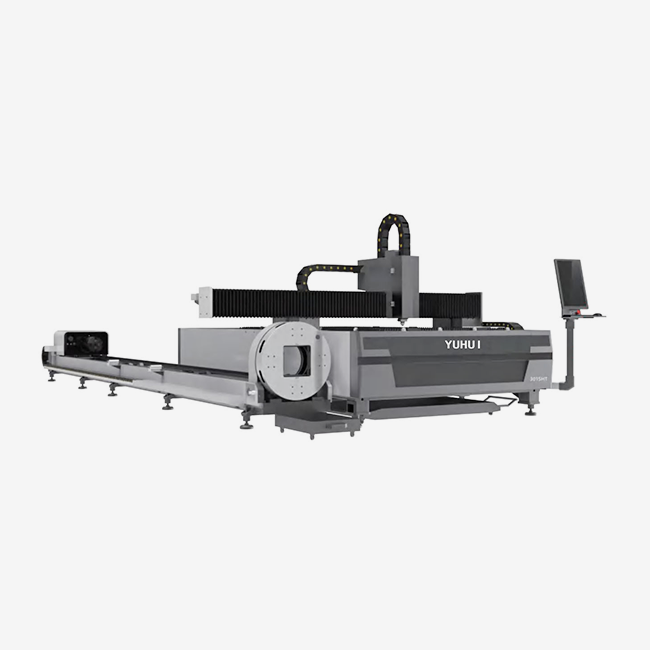
The YH-3015HT to YH-8025HT line of integrated tube and plate tools have both flatbed cutting surfaces and rotating chuck assemblies. The design of the swappable worktable lets workers switch between working modes without having to manually rearrange the tables. This cuts down on changeover downtime by a huge amount. CNC control systems move a linear frame for cutting sheets and a synchronized rotating axis for moving tubes with diameters from 20mm to 225mm. This dual capability solves a major problem for job shops and OEM manufacturers, who used to have to keep different tools for each use, which took up twice as much room and cost twice as much to buy.
Material Compatibility and Performance Boundaries
Fiber lasers work great with metals, but it's important to know the limits of thickness and diameter when planning production. With 6kW power configurations, the YH-HT series can handle stainless steel plates up to 25mm thick. On the other hand, aluminum processing usually stops at 12mm because of problems with reflectivity. Tube cutting skills depend on the wall thickness and diameter ratios. The 225mm maximum diameter standard fits most structural and decorative tube profiles used in making furniture, workout equipment, and buildings. Carbon steel is the most common material that is made because it is easy to cut and is used a lot in industry.

Comparing Fiber Laser Cutting Machines: Making the Right Choice
To choose the right laser technology, you have to weigh the initial investment against the long-term operating costs and the performance needs of the application. Fiber lasers have taken over a big chunk of the market from CO₂ systems, mostly because they use less electricity and are easier to maintain.
Fiber vs. CO2 Technology
Fiber laser sources turn about 30–40% of the electricity that comes in into useful laser output, while CO₂ systems only do this 10–15% of the time. This means less money spent on utilities and less need for a chiller. The solid-state design gets rid of parts that CO₂ lasers need to keep working, like gas mixtures and reflective mirrors. This cuts down on maintenance costs by 60–70% over the life of a five-year ownership period. Fiber systems also offer 2-3 times faster cutting speeds for thin to medium-gauge metal, which is where most makers find their sweet spot. This has a direct effect on output and labor productivity.
Power Output Considerations
Choosing the right laser power for the HT model tube and plate fiber laser cutting machine has a big impact on both capability and budget. The HT model tube and plate fiber laser cutting machine, from the YH-HT line, can be scaled up or down from 3kW to 80kW, but for most general manufacturing tasks, 6kW to 12kW is the best range. With the HT model tube and plate fiber laser cutting machine, a 6kW system can cut 10mm stainless steel at a speed of about 1.5 meters per minute. A 12kW system on the HT model tube and plate fiber laser cutting machine can do twice that. When handling mostly thick materials or doing high-volume production, where shorter cycle times make the extra cost worth it, higher power setups for the HT model tube and plate fiber laser cutting machine are the best choice. The repeat placement accuracy of ±0.03mm at all power levels on the HT model tube and plate fiber laser cutting machine guarantees consistent dimensions no matter the setup.
Evaluating Brand Reputation and Support Infrastructure
Established European names charge higher prices because of their long history, but Chinese makers have made a lot of progress in quality over the last ten years. The CE and ISO approvals from Yuhui Laser show that they follow international quality standards. The THF4 military-grade lens specification shows that their parts are just as good as those from traditional market leaders. A common concern about help accessibility is addressed by the 450-day after-sales service commitment, which goes above and beyond what is expected in the business. The 14-day production lead time gives us a lot of flexibility compared to competitors who have backlogs of 8–12 weeks. This is especially helpful when we need to speed up the timeline for production expansion.
Optimization and Maintenance for Maximum Performance
To get uniform cutting quality across a range of materials, you need to do both the right setup the first time and follow strict care rules every time. Modern equipment has clever control systems that make optimization easier, but operators still need to know a lot about the equipment.
Material-Specific Parameter Optimization
When cutting stainless steel, nitrogen assist gas at 1.2 to 1.8 bar pressure is often used to get edges that are free of oxides and ready to be welded or finished right away. When cutting carbon steel, oxygen is often used to speed up the process through an exothermic reaction. This lets the cutting go faster but causes a little edge oxidation. To control reflectivity and stop edge dross formation, aluminum needs to have its focus position carefully adjusted and its help gases made more pure. The YH-HT series control software keeps files of parameters for common combinations of material and thickness. This lets workers load tried-and-true settings as starting points before fine-tuning for each job.
Preventive Maintenance Protocols
Compared to older technologies, the HT model tube and plate fiber laser cutting machine's fiber laser sources don't need as much maintenance. However, secondary systems do. When working with materials that tend to spatter, protective window inspections on the HT model tube and plate fiber laser cutting machine should happen every day. To clean the windows, lint-free optical-grade wipes and approved solvents should be used. Checking and replacing chiller filters on the HT model tube and plate fiber laser cutting machine every month depends on the temperature and quality of the water. To keep the concentricity within the specifications, the rotary chuck unit of the HT model tube and plate fiber laser cutting machine needs to be oiled every 500 hours of tube handling. By testing the circularity of the ballbar on the HT model tube and plate fiber laser cutting machine every three months, you can find problems with the servo motor or drive system before they affect the quality of the part. This way, you can replace the part before they break during production runs instead of having to fix them after the fact.
Safety Compliance and Operator Training
Laser safety rules protect both people and the money you spend on tools. Class 4 laser systems, like the YH-HT series, need working areas that are sealed and have access panels that are interlocked so that beam output stops when the panels are opened. Operators need to be taught both how to run the machine normally and how to shut it down in an emergency. Proper exhaust ventilation gets rid of fume particles that could otherwise build up on optical parts and lower the quality of the beam. The heavy welded machine body design, which goes through an annealing process at 600°C and a 24-hour vibration aging treatment, makes it more stable and less likely that the parts will not line up correctly than frames that aren't as strong.
Procurement Guide: Buying Your Tube and Plate Fiber Laser Cutting Machine
When you do strategic procurement, you have to weigh your specific application needs against the powers of the tools you can afford. Integrated systems are great because they can be used for two different things at once. This makes them very useful for businesses that work with both sheet and tubular parts.
Defining Application Scope and Capacity Requirements
By mapping your current and planned production mix, you can choose the right work envelope. With a plate area of 3000x1500mm, the YH-3015HT is good for small job shops and companies that make parts that are usually less than one meter long. The YH-6020HT and YH-8025HT types can handle larger pieces, like architectural panels, truck bed parts, or big enclosures, thanks to their larger 6000x2000mm or 8000x2500mm capabilities. Tube processing needs affect chuck specifications. Manufacturers of exercise equipment that work with tubes that are 80 to 120 mm in diameter find standard designs to be sufficient, but structural steel fabricators that work with bigger profiles may need to make changes to reach the 225mm maximum diameter capability.
OEM and Customization Advantages
Because Yuhui Laser is a factory-direct business, it can offer creative customizations for the HT model tube and plate fiber laser cutting machine that bigger companies often can't afford to make. Changes to the HT model tube and plate fiber laser cutting machine can include making the Z-axis move farther for thicker materials, adding automatic loading systems for processing a lot of tubes at once, or creating special fixtures for non-standard shapes like D-sections or curved tubes. Customizing functions for the HT model tube and plate fiber laser cutting machine includes localizing software interfaces, connecting to existing ERP systems to automate nesting and production scheduling, or setting up cutting heads in unique ways for different types of materials. Even for moderately customized configurations, the 14-business-day production lead time for the HT model tube and plate fiber laser cutting machine is a big plus compared to competitors who need 6–8 weeks for special orders.
Total Cost of Ownership Analysis
The price of buying something is only one part of how much it really costs to run over time. Fiber technology's high electricity efficiency cuts power costs by $3,000 to $5,000 a year compared to CO₂ systems of the same type in normal two-shift operations. When estimating maintenance costs, it's important to include things like protected screens ($150 to $300 a year), assist gases (which change depending on the cutting settings), and regular calibration services. Yuhui Laser's extended 450-day after-sales support period is a good deal that should be compared to competitors who only offer 12-month coverage, since service calls usually cost between $800 and $2,000 each after the warranty period ends.
Improving Efficiency and Future Outlook
To get the best return on your laser cutting investment, you need to do more than just choose the right machine. You also need to optimize operations and adopt new technologies strategically. The way fiber lasers are developing points toward systems that are smarter and easier to use while also being more productive.
Bottleneck Identification and Throughput Enhancement
Analysis of production often shows that cutting cycle time is a smaller part of the total time needed to finish a part than was thought. Material handling, optimizing nesting, and post-processing tasks often slow down total output more than raw cutting speed. The YH-HT series' swappable worktable design directly solves the problem of slow loading and unloading by letting the next job be prepared while the current job is still being cut. Using offline stacking software that makes the best use of materials can cut the cost of raw materials by 8–15% and cut down on cutting time by making tool paths more efficient. The 60m/min rapid traverse speed and 1.0G acceleration keep motion between cuts to a minimum, but to reach theoretical capacity, delays in processes upstream and downstream must be eliminated.
Automation Integration Opportunities
Connecting the HT model tube and plate fiber laser cutting machine to the rest of the factory's automation system makes it easier to make more as the output volume rises. The HT model tube and plate fiber laser cutting machine, part of the YH-HT series, can work with automated systems for storing and retrieving materials, which means that for commonly processed stock sizes, no more manual material handling is needed. For processing tubes, the HT model tube and plate fiber laser cutting machine can be equipped with bundle loading systems that line up multiple bars for cutting in order, which changes the job of the user from moving materials to checking the quality. Factory managers can keep an eye on how the HT model tube and plate fiber laser cutting machine is being used, how much material is being used, and what repairs need to be done across multiple shifts without having to be there in person. This lets them make decisions based on data about how to allocate capacity and when to buy new equipment, such as an additional HT model tube and plate fiber laser cutting machine.
Emerging Technology Trends
At the moment, artificial intelligence used in laser cutting is mostly used to make changes to parameters based on feedback about the cutting quality in real time. Machine learning algorithms look at sensor data to find early signs of focusing lens contamination, changes in assist gas pressure, or other issues that hurt edge quality before parts go beyond what is acceptable. Predictive maintenance systems look at motor current signs, vibration patterns, and temperature profiles to figure out when a part will break down days or weeks in advance. This way, the part can be replaced during planned downtime instead of when it breaks down without warning. Connecting to the cloud lets equipment makers offer remote diagnostics and software changes. This cuts down on service response times and makes sure that systems always have the latest control methods.
Conclusion
Investing in dual-purpose fiber laser technology is a smart move that will help your business meet changing market needs while also enhancing its current capabilities. The YH-3015HT to YH-8025HT line, featuring the HT model tube and plate fiber laser cutting machine, gives metal makers the accuracy, dependability, and adaptability they need for a wide range of tasks, from making parts for cars to building structures. With its certified quality standards, fast delivery, wide range of customization options, and long-term service commitment, Yuhui Laser offers the HT model tube and plate fiber laser cutting machine as a value proposition that balances performance with realistic total ownership costs. Your ultimate success in procurement depends on matching the specs of the HT model tube and plate fiber laser cutting machine with what you actually need to make, judging suppliers based on their real-world abilities instead of what they say they can do, and planning for operational integration that makes the most of use from day one.
FAQ
What is the typical lead time for a customized configuration?
Standard YH-HT series machines are sent out 14 business days after an order is confirmed. Moderate customizations, like setting specific power levels, expanding the model's work area, or making changes to the software interface, usually take an extra 7 to 10 days. Lead times may go up to 6–8 weeks if there are a lot of changes to the structure that need to be reviewed by an engineer. However, Yuhui keeps a level of flexibility that larger manufacturers can't match.
Can the system process both reflective metals and ferrous materials?
Yes, modern fiber laser sources have anti-reflection technology that makes working with aluminum, brass, and copper safe. The YH-HT line works well with these materials, but because they don't conduct heat as well as carbon or stainless steel, cutting speeds are slower. It's more important than ever to choose the right parameters and help keep the gas pure when working with reflective materials to get a clean edge.
How quickly can operators switch between plate and tube cutting modes?
Software-driven shifts are used for the change, which usually takes less than two minutes to finish. The control interface lets operators change the mode, which then changes the Z-axis reference points and starts the right kinematic model for either gantry-only motion or synchronized rotary axis motion. The chuck is physically installed when the machine is first set up, and it stays in place no matter what working mode is being used.
Partner with a Reliable Fiber Laser Cutting Machine Manufacturer
Yuhui Laser has tried-and-true tube and plate fiber laser cutting systems that are built to work in tough industrial settings and are ready to help your metal fabrication business grow. With CE certification, THF4 military-grade optics, and our industry-leading 450-day after-sales service commitment, our YH-3015HT through YH-8025HT series gives you the accuracy you need and the flexibility your business needs. Our factory-direct prices and technical know-how give you a competitive edge from the start, whether you need standard configurations delivered quickly in 14 days or custom solutions made to fit your specific production needs. You can email our engineering team at jianghui@yuhui-laser-tech.com to talk about your specific application needs, get full technical specs, or set up a live cutting demonstration. Find out how working with an experienced HT model tube and plate fiber laser cutting machine supplier can change the way you make things and set your business up to stay ahead of the competition in markets that are always changing.
References
1. Wandera, C. (2021). Fiber Laser Cutting: Process Characteristics and Industrial Applications. Materials Processing Institute Technical Report Series.
2. Powell, J., & Kaplan, A. (2020). Laser Cutting Guide for Manufacturing. Springer Series in Materials Science, Volume 185.
3. Ion, J. C. (2019). Laser Processing of Engineering Materials: Principles, Procedure and Industrial Application. Butterworth-Heinemann Engineering Publications.
4. Steen, W. M., & Mazumder, J. (2022). Laser Material Processing: Fourth Edition. Springer Advanced Manufacturing Series.
5. Quintero, F., et al. (2023). "Comparative Analysis of Fiber and CO2 Laser Cutting Systems for Industrial Metal Fabrication." Journal of Manufacturing Science and Engineering, 145(4), pp. 041002-1–041002-12.
6. Rodrigues, G. C., & Santos, E. C. (2024). "Total Cost of Ownership Models for Industrial Laser Cutting Equipment." International Journal of Advanced Manufacturing Technology, 128(7-8), pp. 3341-3356.
Contact us directly for customized solutions, quotations and long-term strategic cooperation.