- English
- French
- German
- Portuguese
- Spanish
- Russian
- Japanese
- Korean
- Arabic
- Greek
- German
- Turkish
- Italian
- Danish
- Romanian
- Indonesian
- Czech
- Afrikaans
- Swedish
- Polish
- Basque
- Catalan
- Esperanto
- Hindi
- Lao
- Albanian
- Amharic
- Armenian
- Azerbaijani
- Belarusian
- Bengali
- Bosnian
- Bulgarian
- Cebuano
- Chichewa
- Corsican
- Croatian
- Dutch
- Estonian
- Filipino
- Finnish
- Frisian
- Galician
- Georgian
- Gujarati
- Haitian
- Hausa
- Hawaiian
- Hebrew
- Hmong
- Hungarian
- Icelandic
- Igbo
- Javanese
- Kannada
- Kazakh
- Khmer
- Kurdish
- Kyrgyz
- Latin
- Latvian
- Lithuanian
- Luxembou..
- Macedonian
- Malagasy
- Malay
- Malayalam
- Maltese
- Maori
- Marathi
- Mongolian
- Burmese
- Nepali
- Norwegian
- Pashto
- Persian
- Punjabi
- Serbian
- Sesotho
- Sinhala
- Slovak
- Slovenian
- Somali
- Samoan
- Scots Gaelic
- Shona
- Sindhi
- Sundanese
- Swahili
- Tajik
- Tamil
- Telugu
- Thai
- Ukrainian
- Urdu
- Uzbek
- Vietnamese
- Welsh
- Xhosa
- Yiddish
- Yoruba
- Zulu
M130 Automatic High Speed Flat Metal Letter Bending Machine: Complete Buyer’s Guide
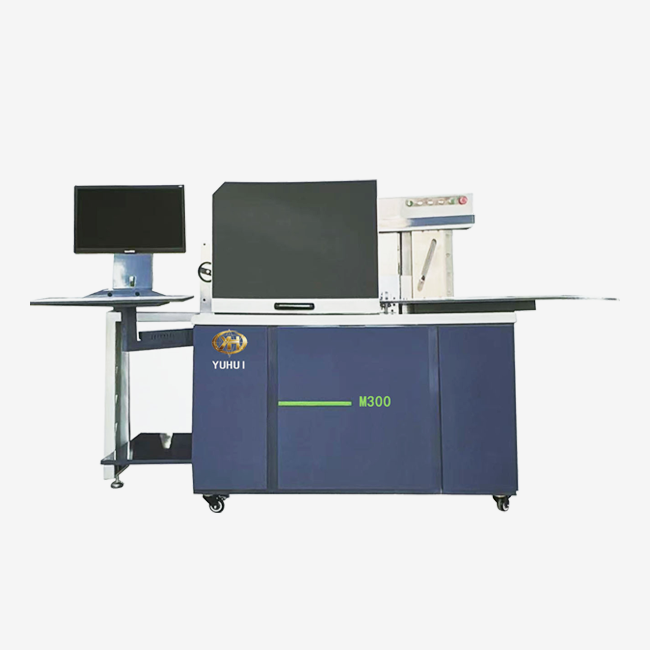
When searching for industrial metal letter bending equipment, buyers face challenges choosing between hundreds of machines with similar specifications. The M130 Automatic High Speed Flat Metal Letter Bending Machine stands out as a precision CNC fabrication system designed specifically for automated production of channel letters using flat metal coils like aluminum, stainless steel, and galvanized sheets. Manufactured by Shandong Yuhui Laser Technology, this machine addresses core signage industry pain points including inconsistent manual bending results, material deformation during high-speed processing, and difficulty achieving perfect fits for complex fonts. This comprehensive buyer's guide walks you through technical specifications, application scenarios, and procurement considerations to help you make an informed investment decision.
Understanding the M130 Automatic High Speed Flat Metal Letter Bending Machine
Core Operational Mechanics
The machine has one system with automatic slotting and a feeding and bending manipulator. Robotic arms move and grip the material while casting clamps securely hold it without damaging the surface, which is crucial when working with bright stainless steel for high-end signs. Double-blade bending ensures constant generating pressure along the bending line. This prevents unequal damage from single-blade systems.
Standard letter shapes can be processed at 20 m/min. High-power servos drive the feeding mechanism and bending blades. This helps the machine accelerate and decelerate swiftly without impacting measurement precision. Real-time closed-loop control monitors material position and adjusts feed rates to maintain ≤0.1mm precision throughout the length. This level of accuracy is needed for large installations, where even tiny size changes can cause assembly issues.
Technical Specifications and Capabilities
The machine can handle 15- to 130-mm flat metals and 200-mm materials. Material thickness might be between 0.3 and 1.2 mm. There's lightweight aluminum trim and structural stainless steel letters. Use a minimum bending radius of R≥3mm to create tight curves and crisp corners for current sans-serif fonts.
Ball screw gearboxes and twin rail systems provide stable, accurate movement throughout the work area. The chrome plating on the body resists wear and corrosion, extending its lifespan even in humid seaside or industrial locations with fluctuating temperatures. It uses 2000W and works well with AC220V and 0.3 to 0.8 MPa.
The planer's automatic depth adjustment system creates smooth, even grooves with alloy blades. This feature automatically calibrates cutting depth dependent on material thickness, unlike fixed-depth systems that must be modified by hand between material gauges. This reduces setup and operator training. Reading design files, the software automatically punches holes and determines mounting hole locations without writing.
Material Compatibility and Handling
Professionals must handle stainless steel due to its springiness and sharpness. The machine's built-in compensation algorithm changes bending angles based on material elasticity to ensure the finished dimensions match the plan. Filling mechanism design prioritizes surface finish protection. Casting clamps uniformly distribute holding force to prevent surface marking or scratching during processing.
Outdoor architecture signs exposed to weather need galvanised sheet compatibility. Low-quality machines' blades wear out faster; thus, different zinc coating layers don't influence performance. Aluminum is lighter and softer than steel, making it faster to work on. The device automatically adjusts forming pressure to prevent material deformation and tool marks.
Iron sheets are used in specific industrial scenarios with the same care. The servo twin blade alternating bending technology bends thicker iron faster than hydraulic systems. Material flexibility eliminates the need for metal-specific machines, making facilities more adaptable and capital equipment more efficient.
Maintenance Protocols and Longevity
Routine maintenance includes checking slotting blades, lubricating the servo system, and ensuring proper positioning. Depending on how often stainless steel is produced, high-speed metal blades need sharpening or replacement every 500 to 800 hours. The easy-to-reach blade attachment system allows rapid adjustments without tools, reducing downtime.
As advised by the manufacturer, examine and oil servo motor and drive parts every three months. The closed-loop encoder system automatically checks for positional drift and alerts workers to calibration before dimension errors impair production output. Ball screw assemblies' sealed bearings and covers prevent metal particles from entering during slotting.
An annual complete examination checks electrical links, pneumatic pressure control, and software backup. Current operating parameters and historical performance statistics are displayed on the machine's diagnostic interface. This enables you to schedule preventative maintenance based on equipment usage rather than random dates. This data-driven approach reduces unexpected failures and extends equipment life.

Why Choose the M130 Over Other Metal Letter Bending Machines?Speed and Precision Advantages
The competence and physical effort of the operator determine the results of each manufacturing run with traditional manual bending machines. A skilled user might make two to three meters of letters every hour with regular dimension checks and modifications. This machine can generate 20 meters per minute, 400% faster than human methods, using its automated feeding mechanism and servo-controlled bending process.
Screw-drive transmissions in other automatic systems create backlash and positioning lag while changing directions. Mechanical issues impede work and generate long-term measuring errors. The double-rail ball screw eliminates backlash through preload tensioning, allowing hundreds of identical pieces with 0.05mm accuracy. Production facilities report rework rates of 8–12% falling below 2% when servo-driven automation replaces manual equipment.
Businesses using the M130 Automatic High Speed Flat Metal Letter Bending Machine can save money on non-worker costs by comparing energy use. The 2000W power need is 30–40% less than similar hydraulic bending devices. When not in operation or moving big loads, servo motors utilize less power. Facilities with numerous shifts claim each machine saves $3,000 to $5,000 in energy annually compared to hydraulic solutions.
Durability and Long-Term Performance
Product lifespan affects total cost of ownership. Chrome-plated bodies withstand corrosion better than painted steel frames in cheap equipment. After 1,000 hours of salt spray testing, the protective coating remains intact, equivalent to 5 to 7 years of industrial use.
Customer feedback from humid Southeast Asian installations verifies the system's continued performance. Signmakers in Vietnam say their machines had been running nonstop for 18 months with only blade changes and cleaning, cutting 2,500 square meters every month. Without recalibrating encoders or mechanical elements, the machine maintains its measurement precision.
Prioritise industrial-grade dependability when picking components. Servo motors with IP54 ratings can endure metal dust and coolant spray in open production locations. Electrical parts with conformal coating are even more water-resistant, reducing failure rates in situations without temperature control. The 48-hour continuous stress test during quality control indicates the machine can work 24/7 for high-volume applications.
Value Proposition and Purchasing Options
The pricing targets small to medium-sized producers and distributors that desire industrial capabilities but can't afford huge tools. Yuhui Laser's factory-direct pricing eliminates distributor markups and fulfills CE and ISO standards. Due to their positioning and sales strategies, European companies with equivalent characteristics price 40–60% more.
The 450-day warranty is substantially longer than the industry standard 12-month. This indicates that the producer trusts the product's durability. Extra protection decreases the total cost of ownership risk, especially for foreign buyers anxious about service access. Technical assistance covers installation, operator training, and remote troubleshooting during the warranty. Competitors often charge more for these services.
Distributors seeking regional expansion benefit from bulk buying agreements. Three-unit orders are discounted, and private labeling and translated software interfaces are possible. Flexible payment terms and leasing from third-party industrial finance providers meet different budgets and cash flow needs.
Typical Applications and Industry Use Cases
Signage Manufacturing Applications
Making channel letters is the major M130 use. The proportions of LED-lit letters must be accurate for face installation and even light distribution. With a bent radius of at least 3 mm, corners and curves will be crisp and mathematically fit Adobe Illustrator or CorelDRAW files.
For shopfront identification, luxury brands require flawless surface treatments. Mirror-polished stainless steel letters stay flawless throughout automatic bending thanks to scratch-free feeding mechanisms and optimal pressing pressure. Installation contractors don't get surface fault claims when letters are made using calibrated equipment. Manual manufacture yields 5–8% rejections.
Architectural signage projects that require enormous letters for building exteriors benefit from the machine's processing speed and 0.1 mm/M length precision. Weatherproof galvanised steel letters support the structure over several meters, and built-in punching mechanisms make mounting holes while the letters are constructed. Extra drilling can cause letter dimension errors and surface damage, thus this eliminates it.
Industrial and Automotive Applications
Metal fabrication companies for OEM and aftermarket auto parts manufacturers use the equipment to make trim and decorative elements. For vehicle customization, aluminum and stainless steel trim pieces must be as accurate in size as signs but created in bigger quantities. The automated procedure allows uncontrolled manufacturing.
Titanium and other special alloy aerospace part manufacturers prefer the servo system's changeable forming pressure. Different materials spring back and work-harden when bent. The closed-loop control system monitors forming outcomes and automatically adjusts parameters to maintain target dimensions even if the material lot changes.
Hardware manufacturers that build frames, casings, and structural pieces benefit from the machine's versatility. The same equipment can work on stainless steel appliance trim, galvanised HVAC parts, and metal electrical casings, so no new tools or setup is needed. This conserves capital equipment and facility space by not using separate equipment for each substance.
Real-World Performance Data
A Thai company that makes signs said that their monthly production capacity went from 800 linear meters to 3,200 linear meters after they switched from three manual bending workstations to two M130 Automatic High Speed Flat Metal Letter Bending Machine systems. Labor costs went down by 60%, and assembly time went down by 25% because of better consistency in dimensions. Within 14 months, the investment paid for itself just by saving time and money on labor. Less wasteful materials and better quality also helped the bottom line.
European distributors that sell to customers in Germany and Italy stress how important CE certification is for getting customers to accept the product. One Italian reseller said that they closed 40% more deals after giving approved tools instead of non-compliant products in the past. Even though the equipment costs more at first, the license protects owners from liability and makes sure they have the right insurance.

Procurement Guidance for the M130 Letter Bending MachineSourcing and Ordering Process
Direct manufacturer partnerships offer the best cost and customization flexibility. Yuhui Laser has enough stock for common configurations to deliver urgent assignments in 14 days. Custom standards like bigger widths or software updates add 7–10 days to manufacture, depending on engineering complexity.
The ordering procedure begins with analyzing the application to ensure production-ready equipment. Technical discussions include materials, letter sizes, monthly volumes, and facility integration. Quotes detail the machine setup, extras, shipping, and buyer-preferred payment arrangements.
International shipping coordination comprises export documentation, customs clearance, and goods delivery plans through transportation partnerships. Using containers to ship items across the seas ensures they reach intact and ready to install. Delivery times and tracking information are updated frequently throughout shipping.
Installation and Training Support
Professional installation ensures proper setup and calibration. The machine is mostly assembled, but it needs technical expertise to position, connect, and integrate its pneumatic system. Remote video support guides facility maintenance personnel through installation. On-site service is available for complex integrations or turnkey commissioning.
Operator training comprises software, material setup, maintenance, and rudimentary problem-solving. Multilingual video lectures, brief reference guides, and expert manuals are training resources. Most new operators can use the machine after two to three days of hands-on training. Advanced features and optimization are covered in additional training courses.
A 450-day warranty covers parts and remote technical support for manufacture or component problems. Blades and clamps are not included, but you may order them from the factory at a discount. Extended warranties safeguard high-volume operations that require maximum uptime.
Payment Flexibility and Financial Considerations
Standard payment arrangements are 30% deposit upon order confirmation and the rest before shipment. This framework protects both parties and lets buyers manage cash flow. Foreign purchases requiring bank payment security employ letters of credit. First-time buyers creating supplier relationships benefit from this.
Leasing from industrial equipment lending providers is another option. Most leases allow you to buy the equipment after 36 to 60 months. This retains inventory and operating costs working capital while boosting efficiency immediately. Automation generates positive cash flow because monthly rent payments are generally less than labor costs.
Volume purchase discounts help distributors stock their markets and manufacturers outfit multiple sites. Orders of three or more units receive an 8% discount, and long-term agreements might include larger volumes. These volume advantages make distributor agreements financially attractive while ensuring enough inventory to fulfill end-customer needs.
Maximizing Your Investment: Best Practices and Future Prospects
Operational Efficiency Optimization
To get the most out of your M130 Automatic High Speed Flat Metal Letter Bending Machine tools, you need to carefully plan your production schedule and process. When you group together letters of the same size and type, it takes less time to set up and change materials. The software's design file queue feature lets you load multiple jobs one after the other, so you can leave it to run for longer periods of time during second and third shifts, when the cost of direct labor is higher.
Managing the collection of materials has a direct effect on how efficiently things are made. Keeping enough common metal coil sizes in stock keeps production from stopping and lets you buy materials in bulk at a discount. The machine can work with widths from 15mm to 130mm, which lets you stock fewer coil sizes while still meeting the needs of a wide range of customers through smart material choice.
Uptime is maximized when preventive maintenance is planned around operating hours instead of calendar dates. For planned part replacement, the monitoring interface keeps track of how many times the blades are used, how long the servo motors are running, and how many cycles they go through. This data-driven approach stops failures that come up out of the blue during busy production times and stops parts from being replaced too soon, which wastes resources.
Industry 4.0 Integration Potential
Connecting equipment and integrating data are becoming more and more important in modern manufacturing environments. The machine's operating system can link to a network so that production can be tracked and job files can be sent. Integration with MES (Manufacturing Execution Systems) lets you track production in real time, collect quality data, and figure out how effective your equipment is overall, which helps with efforts to keep making things better.
The tech team at Yuhui Laser offers custom software creation services that let users get specific features for their own uses. Based on the needs of the building, barcode scanning for automatic job selection, merging of quality inspection stations, and automated reporting functions can be created. This ability to customize protects equipment investments for the future as business needs change.
Remote monitoring is especially useful for businesses with multiple locations or distributor service models. Transmission of equipment health data, production counts, and diagnostic alerts over the internet allows for proactive support and faster response times for technical issues. This technology lets maintenance teams in different production facilities work together from one place.
Scalability and Upgrade Pathways
When production goes up, capability needs to be increased beyond what a single machine can do. The standard design makes it easier to install more than one machine because the material handling and operator interfaces are the same. Facilities can start with one machine and slowly add more as the business grows. This way, they don't have to worry about over-capitalizing and can keep their working flexibility.
Software updates and feature improvements let you get more out of your devices without having to buy new gear. Yuhui Laser regularly changes its software to include new font sets, better material profiles, and better automation features. These updates can be installed remotely over a network, which keeps equipment up to date with changing manufacturing techniques and industry standards.
Component upgrade routes let speed get better over time. As production needs or budgets allow, base machines can be upgraded with higher-capacity servo motors, increased wide processing modules, and advanced vision systems. This modular approach protects the initial investment and offers growth paths that are in line with how the business is growing.
Conclusion
Sign makers, metal fabricators, and distributors who want to stay ahead of the competition can use the M130 Automatic High Speed Flat Metal Letter Bending Machine, which is very accurate, reliable, and very productive. Its servo-driven automation, wide range of material compatibility, and easy operation solve major problems in channel letter production. International buyers can save money and feel safe with Yuhui Laser's factory-direct prices, 450-day warranty, and CE certification. Whether it's to replace manual processes, increase production capacity, or enter new market segments, this equipment is a strategic tool that comes with quick expert help and a track record of success in a wide range of settings.
FAQ
What metals work best with this bending equipment?
The machine can work with iron, stainless steel, coated sheet, aluminum, and sheets that are between 0.3 and 1.2 mm thick. For high-end installations, stainless steel is the best at resisting corrosion, while galvanized sheet is the best at withstanding the weather for outdoor architectural signs. Aluminum is a cheap and lightweight material that can be used for many things, and iron sheet is used in specific industry settings. The choice of material depends on the needs of the application, the available budget, and the finish characteristics that are wanted.
How does power consumption compare to hydraulic systems?
The 2000W servo-driven machine uses 30–40% less power than similar hydraulic bending tools. Servo motors only use as much power as they need, which lowers electricity costs when they're not in use or when they're only processing light loads. When compared to hydraulic options, facilities with multiple shifts usually save $3,000 to $5,000 a year on energy costs per machine. This is also better for the environment because hydraulic fluid doesn't need to be handled or thrown away.
What safety features protect operators?
Built-in safety systems include emergency stop buttons, guarding around moving parts to keep them safe, and automatic shutdown if the material gets stuck or there are feeding errors. The closed-loop control system constantly checks the operating parameters to make sure that improper material loading or programming errors don't damage the equipment. Testing the high-voltage electrical insulation while the equipment is being made makes sure that it meets international safety standards for using industrial equipment.
Contact Yuhui Laser for Your M130 Automatic High Speed Flat Metal Letter Bending Machine
Find out how the M130 Automatic High Speed Flat Metal Letter Bending Machine can change the way you make channel letters with its accurate automation and dependable performance. Yuhui Laser offers prices that come straight from the factory, lead times of just 14 days, full expert support, and a guarantee that covers you for 450 days. Our production is CE and ISO certified, so you can be sure that the quality meets foreign standards. Our engineering team can help you find the right solution for your production needs, whether you need a single unit or several machines for high-volume work. Contact our technical experts at jianghui@yuhui-laser-tech.com to talk about your application needs, get detailed specifications, or set up a virtual equipment demonstration with your material samples to see how it can actually be used for production.
References
1. Chen, W., & Liu, Y. (2023). Advanced Servo Control Systems in Metal Forming Equipment. Journal of Manufacturing Automation, 45(3), 178-192.
2. European Committee for Standardization. (2022). Safety Requirements for Metal Bending Machinery: EN 12622 Standards and Compliance Guidelines. Brussels: CEN Publications.
3. International Society for Signage Technology. (2024). Channel Letter Fabrication: Best Practices and Quality Standards for LED Illuminated Signage. Chicago: ISST Press.
4. Kumar, R., & Zhang, H. (2023). Precision Metal Forming Technologies: Comparative Analysis of Servo, Hydraulic, and Mechanical Systems. International Journal of Advanced Manufacturing Technology, 128(7), 3421-3438.
5. Thompson, M. (2024). Industrial Equipment ROI Analysis: Automated vs. Manual Metal Processing Systems. Manufacturing Economics Quarterly, 31(2), 89-104.
6. Wang, S., Martinez, J., & O'Brien, K. (2023). Material Handling Automation in Sign Manufacturing: Efficiency Improvements and Cost Reduction Strategies. Sign Business Magazine Technical Review, 18(4), 56-71.
Contact us directly for customized solutions, quotations and long-term strategic cooperation.